
輸出切換器是 Cast SDK 的功能,可在 Android 13 以上版本中,在本機和遠端播放內容之間進行無縫轉移。目的是協助傳送端應用程式輕鬆快速地控制內容播放位置。Output Switcher 會使用 MediaRouter 程式庫,在手機喇叭、配對的藍牙裝置和遠端支援 Cast 的裝置之間切換內容播放。用途可細分為下列情境:
請下載並使用 CastVideos-android 範例應用程式,瞭解如何在應用程式中實作輸出裝置切換器。
請按照本指南中的步驟啟用輸出切換器,以支援本機至遠端、遠端至本機和遠端至遠端的連線。不需要額外步驟,即可支援本機裝置喇叭和配對的藍牙裝置之間的轉移。
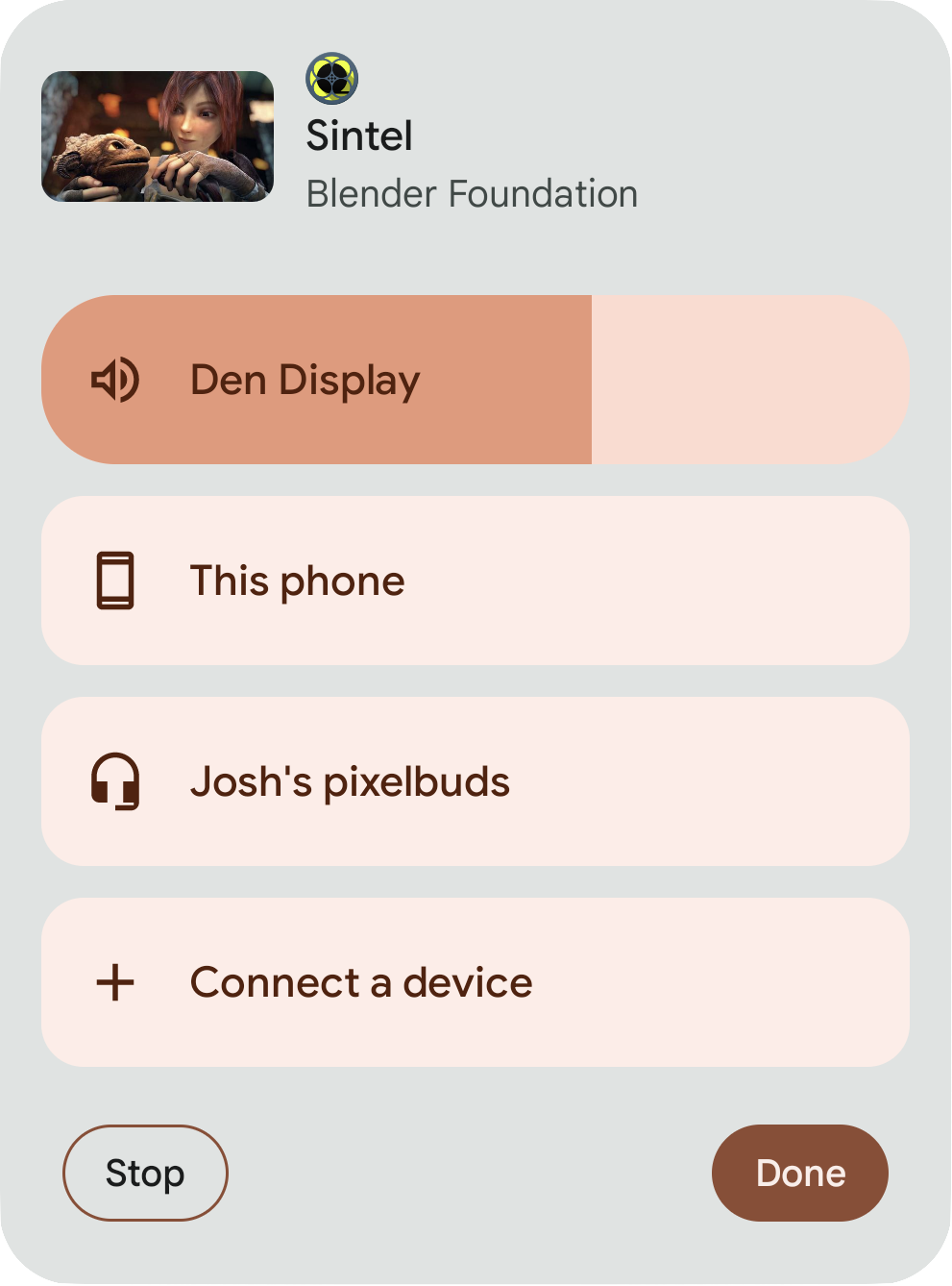
輸出端切換器 UI
輸出切換器會顯示可用的本機和遠端裝置,以及目前的裝置狀態,包括裝置是否已選取、是否正在連線,以及目前的音量。如果除了目前的裝置外,還有其他裝置,點選其他裝置即可將媒體播放內容傳輸至所選裝置。

已知問題
- 當切換至 Cast SDK 通知時,系統會關閉並重新建立為本機播放而建立的媒體工作階段。
進入點
媒體通知
如果應用程式發布含有 MediaSession 的媒體通知,用於在裝置上播放內容,則媒體通知的右上角會顯示通知方塊,其中包含目前播放內容的裝置名稱 (例如手機喇叭)。輕觸通知方塊即可開啟「Output Switcher」對話方塊系統 UI。

音量設定
您也可以按一下裝置上的實體音量鍵、輕觸底部的設定圖示,然後輕觸「在 <投放裝置> 上播放 <應用程式名稱>」文字,觸發輸出切換器對話方塊系統 UI。

步驟摘要
- 確保符合必要條件
- 在 AndroidManifest.xml 中啟用輸出切換器
- 更新背景投放的 SessionManagerListener
- 新增遠端到遠端支援功能
- 設定 setRemoteToLocalEnabled 標記
- 繼續在本機播放
必要條件
- 將現有的 Android 應用程式遷移至 AndroidX。
- 更新應用程式的
build.gradle,以便使用 Android Sender SDK 的最低需求版本,用於輸出切換器:dependencies { ... implementation 'com.google.android.gms:play-services-cast-framework:21.2.0' ... }
- 應用程式支援媒體通知。
- 搭載 Android 13 的裝置。
設定媒體通知
如要使用輸出切換器,音訊和影片應用程式必須建立媒體通知,以便顯示播放狀態和控制項,以便在裝置上播放媒體。這需要建立 MediaSession、使用 MediaSession 的權杖設定 MediaStyle,以及在通知中設定媒體控制項。
如果您目前未使用 MediaStyle 和 MediaSession,請參閱下列程式碼片段,瞭解如何設定這兩項元素,以及如何設定音訊和影片應用程式的媒體工作階段回呼。
// Create a media session. NotificationCompat.MediaStyle // PlayerService is your own Service or Activity responsible for media playback. val mediaSession = MediaSessionCompat(this, "PlayerService") // Create a MediaStyle object and supply your media session token to it. val mediaStyle = Notification.MediaStyle().setMediaSession(mediaSession.sessionToken) // Create a Notification which is styled by your MediaStyle object. // This connects your media session to the media controls. // Don't forget to include a small icon. val notification = Notification.Builder(this@PlayerService, CHANNEL_ID) .setStyle(mediaStyle) .setSmallIcon(R.drawable.ic_app_logo) .build() // Specify any actions which your users can perform, such as pausing and skipping to the next track. val pauseAction: Notification.Action = Notification.Action.Builder( pauseIcon, "Pause", pauseIntent ).build() notification.addAction(pauseAction)
if (android.os.Build.VERSION.SDK_INT >= android.os.Build.VERSION_CODES.O) { // Create a media session. NotificationCompat.MediaStyle // PlayerService is your own Service or Activity responsible for media playback. MediaSession mediaSession = new MediaSession(this, "PlayerService"); // Create a MediaStyle object and supply your media session token to it. Notification.MediaStyle mediaStyle = new Notification.MediaStyle().setMediaSession(mediaSession.getSessionToken()); // Specify any actions which your users can perform, such as pausing and skipping to the next track. Notification.Action pauseAction = Notification.Action.Builder(pauseIcon, "Pause", pauseIntent).build(); // Create a Notification which is styled by your MediaStyle object. // This connects your media session to the media controls. // Don't forget to include a small icon. String CHANNEL_ID = "CHANNEL_ID"; Notification notification = new Notification.Builder(this, CHANNEL_ID) .setStyle(mediaStyle) .setSmallIcon(R.drawable.ic_app_logo) .addAction(pauseAction) .build(); }
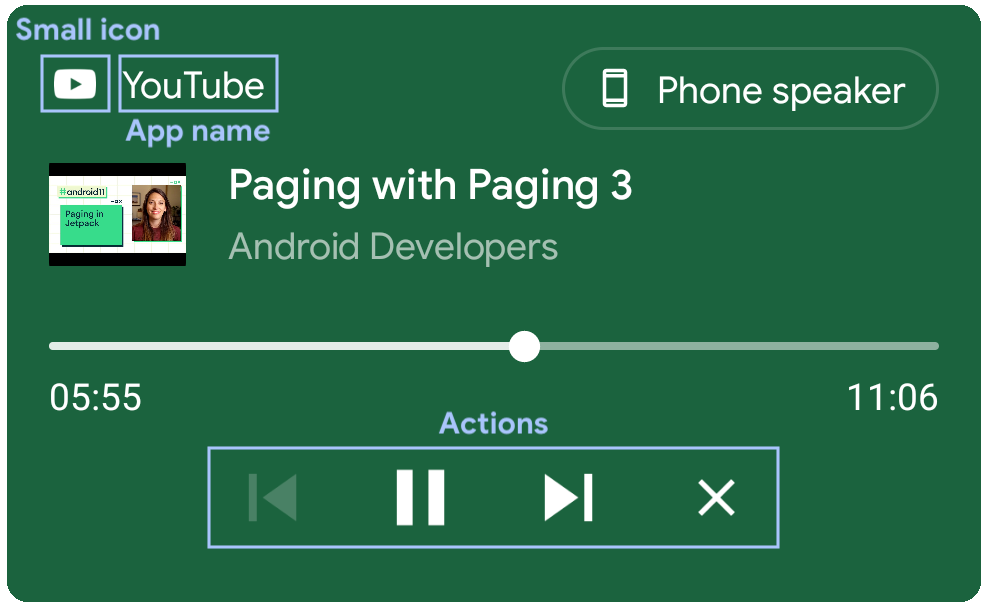
此外,如要讓通知填入媒體資訊,您必須將媒體的中繼資料和播放狀態新增至 MediaSession。
如要將中繼資料新增至 MediaSession,請使用 setMetaData(),並在 MediaMetadataCompat.Builder() 中提供媒體的所有相關 MediaMetadata 常數。
mediaSession.setMetadata(MediaMetadataCompat.Builder() // Title .putString(MediaMetadata.METADATA_KEY_TITLE, currentTrack.title) // Artist // Could also be the channel name or TV series. .putString(MediaMetadata.METADATA_KEY_ARTIST, currentTrack.artist) // Album art // Could also be a screenshot or hero image for video content // The URI scheme needs to be "content", "file", or "android.resource". .putString( MediaMetadata.METADATA_KEY_ALBUM_ART_URI, currentTrack.albumArtUri) ) // Duration // If duration isn't set, such as for live broadcasts, then the progress // indicator won't be shown on the seekbar. .putLong(MediaMetadata.METADATA_KEY_DURATION, currentTrack.duration) .build() )
if (android.os.Build.VERSION.SDK_INT >= android.os.Build.VERSION_CODES.O) { mediaSession.setMetadata( new MediaMetadataCompat.Builder() // Title .putString(MediaMetadata.METADATA_KEY_TITLE, currentTrack.title) // Artist // Could also be the channel name or TV series. .putString(MediaMetadata.METADATA_KEY_ARTIST, currentTrack.artist) // Album art // Could also be a screenshot or hero image for video content // The URI scheme needs to be "content", "file", or "android.resource". .putString(MediaMetadata.METADATA_KEY_ALBUM_ART_URI, currentTrack.albumArtUri) // Duration // If duration isn't set, such as for live broadcasts, then the progress // indicator won't be shown on the seekbar. .putLong(MediaMetadata.METADATA_KEY_DURATION, currentTrack.duration) .build() ); }

如要將播放狀態新增至 MediaSession,請使用 setPlaybackState(),並在 PlaybackStateCompat.Builder() 中提供媒體的所有相關 PlaybackStateCompat 常數。
mediaSession.setPlaybackState( PlaybackStateCompat.Builder() .setState( PlaybackStateCompat.STATE_PLAYING, // Playback position // Used to update the elapsed time and the progress bar. mediaPlayer.currentPosition.toLong(), // Playback speed // Determines the rate at which the elapsed time changes. playbackSpeed ) // isSeekable // Adding the SEEK_TO action indicates that seeking is supported // and makes the seekbar position marker draggable. If this is not // supplied seek will be disabled but progress will still be shown. .setActions(PlaybackStateCompat.ACTION_SEEK_TO) .build() )
if (android.os.Build.VERSION.SDK_INT >= android.os.Build.VERSION_CODES.O) { mediaSession.setPlaybackState( new PlaybackStateCompat.Builder() .setState( PlaybackStateCompat.STATE_PLAYING, // Playback position // Used to update the elapsed time and the progress bar. mediaPlayer.currentPosition.toLong(), // Playback speed // Determines the rate at which the elapsed time changes. playbackSpeed ) // isSeekable // Adding the SEEK_TO action indicates that seeking is supported // and makes the seekbar position marker draggable. If this is not // supplied seek will be disabled but progress will still be shown. .setActions(PlaybackStateCompat.ACTION_SEEK_TO) .build() ); }

影片應用程式通知行為
不支援背景本地播放的影片或音訊應用程式,應針對媒體通知提供特定行為,以免在無法播放的情況下傳送媒體指令時發生問題:
- 在本機播放媒體且應用程式處於前景時發布媒體通知。
- 在應用程式處於背景時,暫停本機播放並關閉通知。
- 當應用程式回到前景時,本機播放應會恢復,並重新發布通知。
在 AndroidManifest.xml 中啟用輸出端切換器
如要啟用輸出端切換器,請將 MediaTransferReceiver 新增至應用程式的 AndroidManifest.xml。如果未啟用,則無法啟用這項功能,且遠端至本機功能旗標也會失效。
<application> ... <receiver android:name="androidx.mediarouter.media.MediaTransferReceiver" android:exported="true"> </receiver> ... </application> MediaTransferReceiver 是廣播接收器,可在裝置之間透過系統 UI 進行媒體傳輸。詳情請參閱 MediaTransferReceiver 參考資料。
本機到遠端
當使用者將播放內容從本機切換至遠端時,Cast SDK 會自動啟動 Cast 工作階段。不過,應用程式需要處理從本機切換至遠端的情況,例如停止本機播放並載入投放裝置上的媒體。應用程式應使用 onSessionStarted() 和 onSessionEnded() 回呼,監聽 Cast SessionManagerListener,並在收到 Cast SessionManager 回呼時處理動作。應用程式應確保在開啟「Output Switcher」對話方塊且應用程式不在前景執行時,這些回呼仍可正常運作。
更新背景投放的 SessionManagerListener
在應用程式處於前景時,舊版投放體驗已支援本機到遠端的功能。使用者在應用程式中點選「投放」圖示,並選取要串流媒體的裝置,即可開始一般投放體驗。在這種情況下,應用程式需要在 onCreate() 或 onStart() 中註冊至 SessionManagerListener,並取消註冊應用程式活動的 onStop() 或 onDestroy() 中的監聽器。
透過使用輸出切換器進行投放的新體驗,應用程式可以在背景開始投放。這對於在背景播放時發布通知的音訊應用程式特別實用。應用程式可以在服務的 onCreate() 中註冊 SessionManager 事件監聽器,並在服務的 onDestroy() 中取消註冊。應用程式在背景執行時,應一律收到本機至遠端的回呼 (例如 onSessionStarted)。
如果應用程式使用 MediaBrowserService,建議您在該處註冊 SessionManagerListener。
class MyService : Service() { private var castContext: CastContext? = null protected fun onCreate() { castContext = CastContext.getSharedInstance(this) castContext .getSessionManager() .addSessionManagerListener(sessionManagerListener, CastSession::class.java) } protected fun onDestroy() { if (castContext != null) { castContext .getSessionManager() .removeSessionManagerListener(sessionManagerListener, CastSession::class.java) } } }
public class MyService extends Service { private CastContext castContext; @Override protected void onCreate() { castContext = CastContext.getSharedInstance(this); castContext .getSessionManager() .addSessionManagerListener(sessionManagerListener, CastSession.class); } @Override protected void onDestroy() { if (castContext != null) { castContext .getSessionManager() .removeSessionManagerListener(sessionManagerListener, CastSession.class); } } }
在這個更新中,當應用程式處於背景時,本地到遠端的行為與傳統投放相同,而且不需要額外工作就能從藍牙裝置切換到投放裝置。
遠端到本機
輸出切換器可讓您從遠端播放轉移至手機喇叭或本機藍牙裝置。如要啟用此功能,請將 CastOptions 上的 setRemoteToLocalEnabled 旗標設為 true。
如果目前的傳送端裝置加入具有多個傳送端的現有工作階段,且應用程式需要檢查目前的媒體是否允許在本機傳輸,應用程式應使用 SessionTransferCallback 的 onTransferred 回呼來檢查 SessionState。
設定 setRemoteToLocalEnabled 標記
CastOptions.Builder 提供 setRemoteToLocalEnabled,可在有 Cast 工作階段時,在輸出端切換器對話方塊中顯示或隱藏手機喇叭和本機藍牙裝置,做為轉移至目標。
class CastOptionsProvider : OptionsProvider { fun getCastOptions(context: Context?): CastOptions { ... return Builder() ... .setRemoteToLocalEnabled(true) .build() } }
public class CastOptionsProvider implements OptionsProvider { @Override public CastOptions getCastOptions(Context context) { ... return new CastOptions.Builder() ... .setRemoteToLocalEnabled(true) .build() } }
在本機上繼續播放
支援遠端至本機的應用程式應註冊 SessionTransferCallback,以便在事件發生時收到通知,並檢查是否應允許媒體轉移至本機並繼續播放。
CastContext#addSessionTransferCallback(SessionTransferCallback) 可讓應用程式在傳送者轉移至本機播放時,註冊其 SessionTransferCallback,並監聽 onTransferred 和 onTransferFailed 回呼。
應用程式註銷其 SessionTransferCallback 後,就不會再收到 SessionTransferCallback。
SessionTransferCallback 是現有 SessionManagerListener 回呼的擴充功能,會在 onSessionEnded 觸發後觸發。遠端至本機回呼的順序如下:
onTransferringonSessionEndingonSessionEndedonTransferred
由於媒體通知元件可在應用程式處於背景並投放時開啟輸出切換器,因此應用程式需要根據是否支援背景播放,以不同方式處理轉移至本機的作業。如果轉移失敗,onTransferFailed 會在發生錯誤時隨時觸發。
支援背景播放的應用程式
對於支援背景播放的應用程式 (通常是音訊應用程式),建議使用 Service (例如 MediaBrowserService)。服務應監聽 onTransferred 回呼,並在應用程式處於前景或背景時,在本機繼續播放。
class MyService : Service() { private var castContext: CastContext? = null private var sessionTransferCallback: SessionTransferCallback? = null protected fun onCreate() { castContext = CastContext.getSharedInstance(this) castContext.getSessionManager() .addSessionManagerListener(sessionManagerListener, CastSession::class.java) sessionTransferCallback = MySessionTransferCallback() castContext.addSessionTransferCallback(sessionTransferCallback) } protected fun onDestroy() { if (castContext != null) { castContext.getSessionManager() .removeSessionManagerListener(sessionManagerListener, CastSession::class.java) if (sessionTransferCallback != null) { castContext.removeSessionTransferCallback(sessionTransferCallback) } } } class MySessionTransferCallback : SessionTransferCallback() { fun onTransferring(@SessionTransferCallback.TransferType transferType: Int) { // Perform necessary steps prior to onTransferred } fun onTransferred(@SessionTransferCallback.TransferType transferType: Int, sessionState: SessionState?) { if (transferType == SessionTransferCallback.TRANSFER_TYPE_FROM_REMOTE_TO_LOCAL) { // Remote stream is transferred to the local device. // Retrieve information from the SessionState to continue playback on the local player. } } fun onTransferFailed(@SessionTransferCallback.TransferType transferType: Int, @SessionTransferCallback.TransferFailedReason transferFailedReason: Int) { // Handle transfer failure. } } }
public class MyService extends Service { private CastContext castContext; private SessionTransferCallback sessionTransferCallback; @Override protected void onCreate() { castContext = CastContext.getSharedInstance(this); castContext.getSessionManager() .addSessionManagerListener(sessionManagerListener, CastSession.class); sessionTransferCallback = new MySessionTransferCallback(); castContext.addSessionTransferCallback(sessionTransferCallback); } @Override protected void onDestroy() { if (castContext != null) { castContext.getSessionManager() .removeSessionManagerListener(sessionManagerListener, CastSession.class); if (sessionTransferCallback != null) { castContext.removeSessionTransferCallback(sessionTransferCallback); } } } public static class MySessionTransferCallback extends SessionTransferCallback { public MySessionTransferCallback() {} @Override public void onTransferring(@SessionTransferCallback.TransferType int transferType) { // Perform necessary steps prior to onTransferred } @Override public void onTransferred(@SessionTransferCallback.TransferType int transferType, SessionState sessionState) { if (transferType==SessionTransferCallback.TRANSFER_TYPE_FROM_REMOTE_TO_LOCAL) { // Remote stream is transferred to the local device. // Retrieve information from the SessionState to continue playback on the local player. } } @Override public void onTransferFailed(@SessionTransferCallback.TransferType int transferType, @SessionTransferCallback.TransferFailedReason int transferFailedReason) { // Handle transfer failure. } } }
不支援背景播放的應用程式
對於不支援背景播放的應用程式 (通常是影片應用程式),建議您監聽 onTransferred 回呼,並在應用程式處於前景時在本機繼續播放。
如果應用程式處於背景執行狀態,應暫停播放,並儲存 SessionState 中的必要資訊 (例如媒體中繼資料和播放位置)。當應用程式從背景切換至前景時,本機播放功能應會繼續使用已儲存的資訊。
class MyActivity : AppCompatActivity() { private var castContext: CastContext? = null private var sessionTransferCallback: SessionTransferCallback? = null protected fun onCreate() { castContext = CastContext.getSharedInstance(this) castContext.getSessionManager() .addSessionManagerListener(sessionManagerListener, CastSession::class.java) sessionTransferCallback = MySessionTransferCallback() castContext.addSessionTransferCallback(sessionTransferCallback) } protected fun onDestroy() { if (castContext != null) { castContext.getSessionManager() .removeSessionManagerListener(sessionManagerListener, CastSession::class.java) if (sessionTransferCallback != null) { castContext.removeSessionTransferCallback(sessionTransferCallback) } } } class MySessionTransferCallback : SessionTransferCallback() { fun onTransferring(@SessionTransferCallback.TransferType transferType: Int) { // Perform necessary steps prior to onTransferred } fun onTransferred(@SessionTransferCallback.TransferType transferType: Int, sessionState: SessionState?) { if (transferType == SessionTransferCallback.TRANSFER_TYPE_FROM_REMOTE_TO_LOCAL) { // Remote stream is transferred to the local device. // Retrieve information from the SessionState to continue playback on the local player. } } fun onTransferFailed(@SessionTransferCallback.TransferType transferType: Int, @SessionTransferCallback.TransferFailedReason transferFailedReason: Int) { // Handle transfer failure. } } }
public class MyActivity extends AppCompatActivity { private CastContext castContext; private SessionTransferCallback sessionTransferCallback; @Override protected void onCreate() { castContext = CastContext.getSharedInstance(this); castContext .getSessionManager() .addSessionManagerListener(sessionManagerListener, CastSession.class); sessionTransferCallback = new MySessionTransferCallback(); castContext.addSessionTransferCallback(sessionTransferCallback); } @Override protected void onDestroy() { if (castContext != null) { castContext .getSessionManager() .removeSessionManagerListener(sessionManagerListener, CastSession.class); if (sessionTransferCallback != null) { castContext.removeSessionTransferCallback(sessionTransferCallback); } } } public static class MySessionTransferCallback extends SessionTransferCallback { public MySessionTransferCallback() {} @Override public void onTransferring(@SessionTransferCallback.TransferType int transferType) { // Perform necessary steps prior to onTransferred } @Override public void onTransferred(@SessionTransferCallback.TransferType int transferType, SessionState sessionState) { if (transferType==SessionTransferCallback.TRANSFER_TYPE_FROM_REMOTE_TO_LOCAL) { // Remote stream is transferred to the local device. // Retrieve information from the SessionState to continue playback on the local player. } } @Override public void onTransferFailed(@SessionTransferCallback.TransferType int transferType, @SessionTransferCallback.TransferFailedReason int transferFailedReason) { // Handle transfer failure. } } }
遙控器對遙控器
輸出端切換器支援使用「串流擴充」功能,將音訊應用程式擴展至多個支援 Cast 的喇叭裝置。
音訊應用程式是指在 Google Cast SDK 開發人員控制台的接收器應用程式設定中支援 Google Cast for Audio 的應用程式

使用音箱擴大串流內容
使用輸出切換器的音訊應用程式,可在投放工作階段中使用串流擴充功能,將音訊擴展至多個支援 Cast 的音箱裝置。
Cast 平台支援這項功能,如果應用程式使用預設 UI,就不需要進行任何進一步變更。如果使用自訂 UI,應用程式應更新 UI,以反映應用程式正在投放至群組。


如要在串流擴展期間取得新的展開群組名稱,請使用 CastSession#addCastListener 註冊 Cast.Listener。然後在 onDeviceNameChanged 回呼期間呼叫 CastSession#getCastDevice()。
class MyActivity : Activity() { private var mCastSession: CastSession? = null private lateinit var mCastContext: CastContext private lateinit var mSessionManager: SessionManager private val mSessionManagerListener: SessionManagerListener<CastSession> = SessionManagerListenerImpl() private val mCastListener = CastListener() private inner class SessionManagerListenerImpl : SessionManagerListener<CastSession?> { override fun onSessionStarting(session: CastSession?) {} override fun onSessionStarted(session: CastSession?, sessionId: String) { addCastListener(session) } override fun onSessionStartFailed(session: CastSession?, error: Int) {} override fun onSessionSuspended(session: CastSession?, reason Int) { removeCastListener() } override fun onSessionResuming(session: CastSession?, sessionId: String) {} override fun onSessionResumed(session: CastSession?, wasSuspended: Boolean) { addCastListener(session) } override fun onSessionResumeFailed(session: CastSession?, error: Int) {} override fun onSessionEnding(session: CastSession?) {} override fun onSessionEnded(session: CastSession?, error: Int) { removeCastListener() } } private inner class CastListener : Cast.Listener() { override fun onDeviceNameChanged() { mCastSession?.let { val castDevice = it.castDevice val deviceName = castDevice.friendlyName // Update UIs with the new cast device name. } } } private fun addCastListener(castSession: CastSession) { mCastSession = castSession mCastSession?.addCastListener(mCastListener) } private fun removeCastListener() { mCastSession?.removeCastListener(mCastListener) } override fun onCreate(savedInstanceState: Bundle?) { super.onCreate(savedInstanceState) mCastContext = CastContext.getSharedInstance(this) mSessionManager = mCastContext.sessionManager mSessionManager.addSessionManagerListener(mSessionManagerListener, CastSession::class.java) } override fun onDestroy() { super.onDestroy() mSessionManager.removeSessionManagerListener(mSessionManagerListener, CastSession::class.java) } }
public class MyActivity extends Activity { private CastContext mCastContext; private CastSession mCastSession; private SessionManager mSessionManager; private SessionManagerListener<CastSession> mSessionManagerListener = new SessionManagerListenerImpl(); private Cast.Listener mCastListener = new CastListener(); private class SessionManagerListenerImpl implements SessionManagerListener<CastSession> { @Override public void onSessionStarting(CastSession session) {} @Override public void onSessionStarted(CastSession session, String sessionId) { addCastListener(session); } @Override public void onSessionStartFailed(CastSession session, int error) {} @Override public void onSessionSuspended(CastSession session, int reason) { removeCastListener(); } @Override public void onSessionResuming(CastSession session, String sessionId) {} @Override public void onSessionResumed(CastSession session, boolean wasSuspended) { addCastListener(session); } @Override public void onSessionResumeFailed(CastSession session, int error) {} @Override public void onSessionEnding(CastSession session) {} @Override public void onSessionEnded(CastSession session, int error) { removeCastListener(); } } private class CastListener extends Cast.Listener { @Override public void onDeviceNameChanged() { if (mCastSession == null) { return; } CastDevice castDevice = mCastSession.getCastDevice(); String deviceName = castDevice.getFriendlyName(); // Update UIs with the new cast device name. } } private void addCastListener(CastSession castSession) { mCastSession = castSession; mCastSession.addCastListener(mCastListener); } private void removeCastListener() { if (mCastSession != null) { mCastSession.removeCastListener(mCastListener); } } @Override protected void onCreate(Bundle savedInstanceState) { super.onCreate(savedInstanceState); mCastContext = CastContext.getSharedInstance(this); mSessionManager = mCastContext.getSessionManager(); mSessionManager.addSessionManagerListener(mSessionManagerListener, CastSession.class); } @Override protected void onDestroy() { super.onDestroy(); mSessionManager.removeSessionManagerListener(mSessionManagerListener, CastSession.class); } }
測試遠端對遠端
如要測試這項功能,請按照下列步驟操作: